
Sciatica is a symptom — sharp, radiating nerve pain that travels from your lower back down through the buttock and leg — while a herniated disc is a structural condition in your spine that is one of the most common causes of that pain. In other words, they aren’t two competing problems you have to choose between. A herniated disc in your lower back can press on a nerve root and produce sciatica, but sciatica can also stem from other issues entirely, and many herniated discs cause no pain at all. Understanding which one you’re dealing with — symptom, cause, or both — is what determines the right treatment path. This guide breaks down the sciatica vs herniated disc question clearly, so Chicago residents can make informed decisions about their care.
Understanding Sciatica
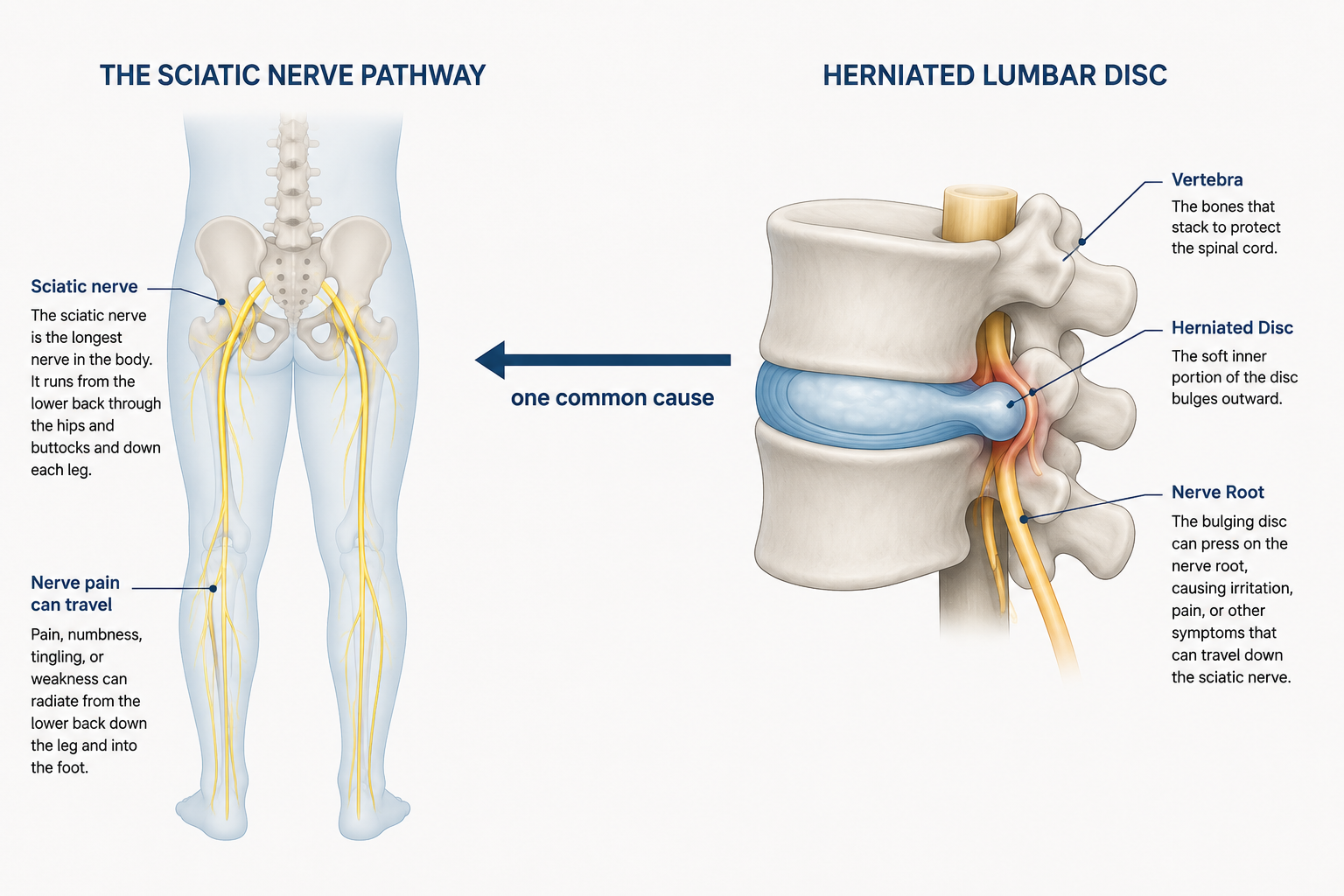
Sciatica describes a specific pattern of symptoms caused by irritation or compression of the sciatic nerve — the longest and widest nerve in your body, running from the lower spine through each buttock and down the back of each leg. Crucially, sciatica is not a diagnosis on its own. It’s the body’s signal that something is pressing on or inflaming the nerve.
How it works: When one of the nerve roots that feed into the sciatic nerve (typically in the L4–S3 region of the lower spine) gets compressed or inflamed, the pain doesn’t stay put. It radiates. People often describe it as a burning, shooting, or electric sensation down one leg, sometimes accompanied by tingling, numbness, or weakness. It usually affects just one side of the body.
Common causes of sciatica include: a herniated disc (the most frequent culprit), spinal stenosis, piriformis syndrome, spondylolisthesis, bone spurs, and even pregnancy. This is the heart of the sciatica vs herniated disc confusion — a herniated disc is just one of several things that can trigger sciatica.
Typical treatment & cost considerations: Most cases respond to conservative, non-surgical care, which is often the first approach for sciatica relief. This can include chiropractic adjustments, physical therapy, targeted stretching, and anti-inflammatory measures. Out-of-pocket costs for conservative care vary widely depending on your insurance, the number of visits, and the underlying cause — many patients find that a structured plan of conservative care is considerably less costly than surgical intervention, though individual results and pricing always vary.
Ideal candidates for a sciatica-focused evaluation: anyone experiencing radiating leg pain, especially if it worsens with sitting, standing up, or — a familiar reality for Chicago commuters — long stretches hunched on the L or behind the wheel in rush-hour traffic.
Understanding a Herniated Disc
A herniated disc is an anatomical change in the spine. Between each pair of vertebrae sits a disc that acts as a cushion. Each disc has a tough outer ring (the annulus) and a soft, gel-like center (the nucleus). When the outer ring weakens or tears, the inner material can bulge or push outward — that’s a herniation (sometimes called a slipped or ruptured disc).
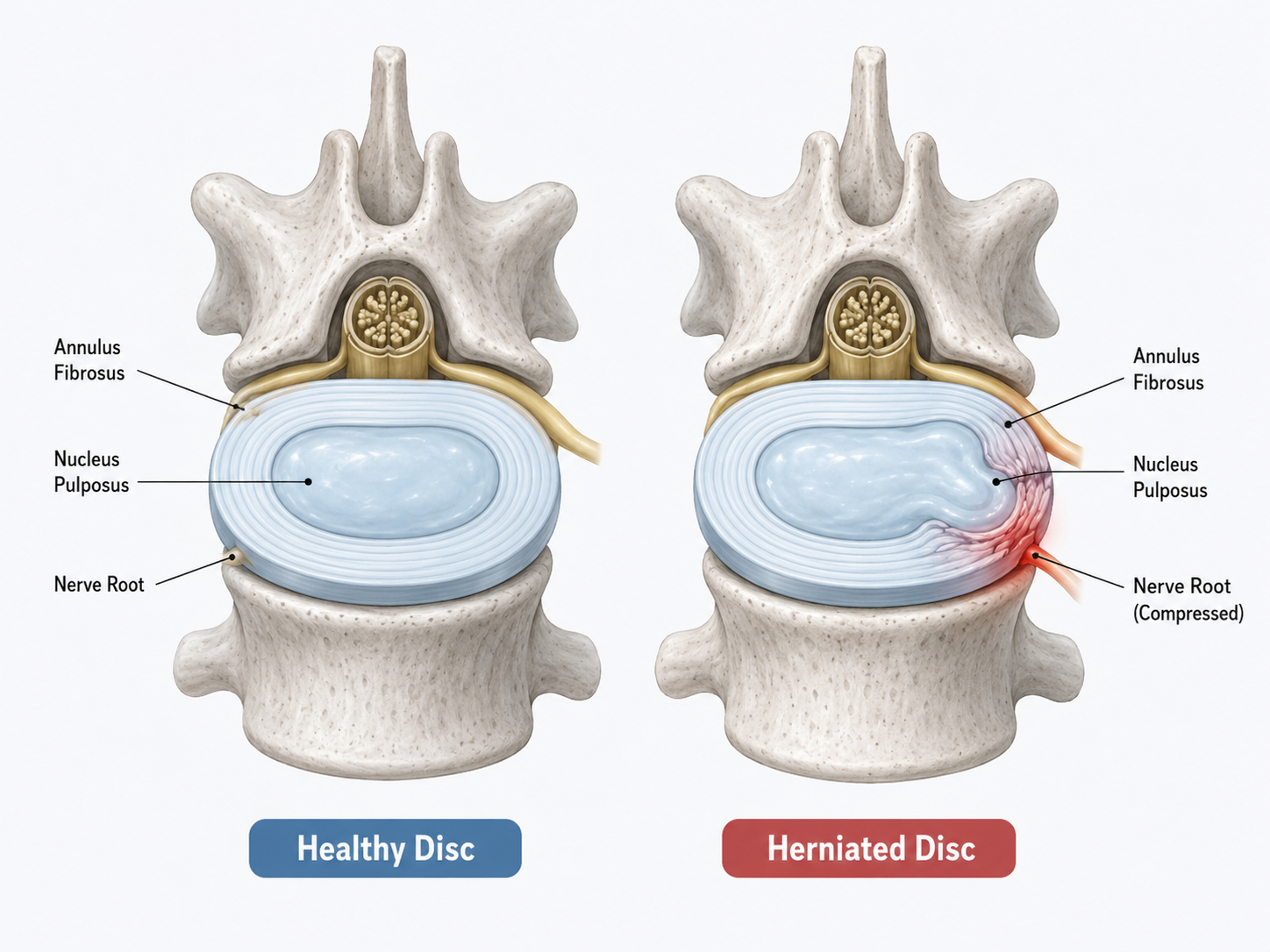 How it works: A herniated disc becomes a problem mainly when the displaced material presses on a nearby nerve root or the spinal canal. In the lower back (lumbar spine), that pressure on a nerve root is exactly what can produce sciatica. In the neck (cervical spine), a herniation tends to cause arm pain instead. Critically, a herniated disc can also be completely silent — imaging studies routinely find herniated discs in people with no pain whatsoever, which is why a scan alone never tells the full story.
Common causes: age-related disc wear, sudden injury (a car accident or a slip on an icy Chicago sidewalk), repetitive strain, improper lifting, and prolonged poor posture. Demanding winters often mean more snow-shoveling injuries and more aggravated discs at clinics across the city.
Typical treatment & cost considerations: Like sciatica, most herniated discs are first managed conservatively — chiropractic care, gentle spinal adjustments, and therapies such as mechanical traction to relieve pressure on the affected nerve. A smaller subset of severe or persistent cases may require advanced pain management or, rarely, surgical consultation. Costs scale with severity and approach; conservative care typically sits at the lower end, while imaging and surgery sit at the higher end.
Side-by-Side Comparison
| Attribute | Sciatica | Herniated Disc |
|---|---|---|
| What it actually is | A symptom — a pattern of nerve pain | A structural condition — physical disc damage |
| Primary location of pain | Radiates from lower back down one leg | Localized at the disc, or refers to a nerve’s path |
| Relationship to the other | Can be caused by a herniated disc — or by other issues | Can cause sciatica — or cause no symptoms at all |
| Common causes / triggers | Disc herniation, stenosis, piriformis syndrome, pregnancy | Age, injury, repetitive strain, poor lifting, posture |
| How it’s identified | Clinical exam, symptom pattern, nerve testing | Clinical exam plus imaging, usually MRI, to confirm |
| Typical first-line treatment | Conservative care: adjustments, PT, stretching | Conservative care: adjustments, traction, therapy |
| Can exist without the other? | Yes — many causes besides a herniated disc | Yes — many herniated discs are painless |
Key Signs & Considerations
Signs you may be dealing with sciatica (the symptom):
- Pain radiates down the leg — typically one-sided, following the nerve’s path rather than staying in the back.
- Burning, tingling, or “pins and needles” — sensations that travel rather than sit in one spot.
- Worsens with sitting or sudden movement — coughing, sneezing, or standing up can spike the pain.
- It points to a cause, not a final answer — sciatica is the clue that prompts a proper neurodiagnostic evaluation to find the source.
Things to keep in mind about sciatica:
- It’s a description of pain, not a root-cause diagnosis — treating only the symptom without identifying the cause often leads to recurrence.
- The same leg pain can come from very different underlying problems, so self-diagnosis is unreliable.
Signs you may be dealing with a herniated disc (the condition):
- A specific point of spinal pain — often in the lower back or neck, sometimes triggered by a clear event like a lift or a fall.
- Pain that follows one nerve’s distribution — leg pain for a lumbar herniation, arm pain for a cervical one.
- Possible weakness or numbness in the muscles served by the affected nerve.
- It’s confirmable — imaging can verify the herniation, which a symptom alone cannot.
Things to keep in mind about a herniated disc:
- A herniation visible on an MRI isn’t always the source of your pain — many are incidental and painless.
- Severity ranges enormously, from a minor bulge needing rest to a significant rupture warranting closer evaluation.
Which Are You Dealing With? (Symptom vs. Cause)
Because this isn’t an either/or contest, the real question in the sciatica vs herniated disc comparison isn’t “which is better” — it’s “which am I experiencing, and what’s driving it?” Here’s how to think about it:
You’re likely dealing primarily with sciatica as a standalone symptom if your leg pain is clearly radiating and one-sided, but a clinical exam doesn’t point to disc damage — the cause may instead be something like piriformis syndrome or general nerve irritation. The priority here is identifying that root cause and calming the nerve, often through conservative back pain care.
You’re likely dealing with a herniated disc (which may also be causing your sciatica) if your pain began after a specific injury or strain, localizes to one spot in the spine, and follows a single nerve’s path with weakness or numbness. Here the priority is relieving pressure on the nerve and supporting the disc — a scenario where many Chicago patients explore chiropractic care for a herniated disc.
The honest bottom line: in a large share of cases, both are true at once — a herniated disc in the lower back is pressing on a nerve root and producing the sciatica you feel. That’s precisely why a hands-on evaluation matters more than guessing. Treating the visible symptom while ignoring the structural cause tends to bring the pain right back; addressing the cause is what supports lasting relief.
A Note for Chicago Residents: Getting Evaluated
You don’t have to untangle the sciatica vs herniated disc question alone. A qualified provider can examine you, run appropriate testing, and explain whether your pain is a symptom, a structural issue, or both — then build a plan around your specific situation. Whether your back pain started after a car accident on the Kennedy, a workplace injury, or simply years of desk work in the Loop, a proper assessment is the first step toward feeling like yourself again.
If you’re in the area and want clarity on your own pain, the team at Grandview Health Partners offers consultations for sciatica, herniated discs, and related spinal conditions. There’s no pressure — just a clear, professional look at what’s going on and your options for relief.
Conclusion & Recommendation
The cleanest way to remember the sciatica vs herniated disc distinction is this: sciatica is what you feel, and a herniated disc is one of the things that can cause it. One is a symptom; the other is a structure. They overlap constantly, but they are not the same — and they are not a choice you make between two products. The most reliable path forward isn’t deciding which label fits best on your own; it’s getting a professional evaluation that identifies the actual source of your pain so it can be treated at the root. For most people, conservative, non-surgical care is the sensible starting point, and Chicago residents have accessible options for exactly that kind of assessment.
Frequently Asked Questions
1. Is sciatica the same thing as a herniated disc?
1. Is sciatica the same thing as a herniated disc?
No. Sciatica is a symptom — radiating nerve pain down the leg — while a herniated disc is a structural condition in the spine. A herniated disc is one of the most common causes of sciatica, but they are not the same, and either can occur without the other.
2. Can you have a herniated disc without sciatica?
2. Can you have a herniated disc without sciatica?
Yes. Many herniated discs cause no symptoms at all and are only discovered incidentally on imaging. A herniation typically produces pain only when it presses on or irritates a nearby nerve.
3. Can you have sciatica without a herniated disc?
3. Can you have sciatica without a herniated disc?
Absolutely. Sciatica can be caused by spinal stenosis, piriformis syndrome, spondylolisthesis, bone spurs, or even pregnancy. A herniated disc is just the most frequent cause, not the only one.
4. How do doctors tell the difference between sciatica and a herniated disc?
4. How do doctors tell the difference between sciatica and a herniated disc?
Sciatica is identified through a clinical exam and symptom pattern, often supported by nerve testing. Confirming a herniated disc usually requires imaging, such as an MRI, in addition to a physical examination.
5. Which is more serious, sciatica or a herniated disc?
5. Which is more serious, sciatica or a herniated disc?
Neither is inherently “more serious” — severity depends on the individual case. Mild sciatica may resolve with conservative care, while a significant herniation pressing on a nerve can be more involved. A professional evaluation is the only reliable way to gauge severity.
6. Can a chiropractor help with sciatica caused by a herniated disc?
6. Can a chiropractor help with sciatica caused by a herniated disc?
Many people pursue conservative chiropractic care for both. Approaches such as spinal adjustments and mechanical traction aim to relieve pressure on the affected nerve. Results vary by person, and a provider can advise whether you’re a good candidate.
7. Does cold Chicago weather make sciatica or a herniated disc worse?
7. Does cold Chicago weather make sciatica or a herniated disc worse?
Many patients report that cold weather and reduced activity can stiffen muscles and aggravate existing back pain. While weather doesn’t cause a herniated disc, winter activities like snow shoveling are a common trigger for new flare-ups.
8. When should I see a professional about back or leg pain?
8. When should I see a professional about back or leg pain?
Consider an evaluation if pain persists beyond a week or two, radiates down the leg, or is accompanied by numbness or weakness. Seek prompt care if you experience loss of bladder or bowel control or sudden, severe weakness, as these can signal a more urgent issue.


