
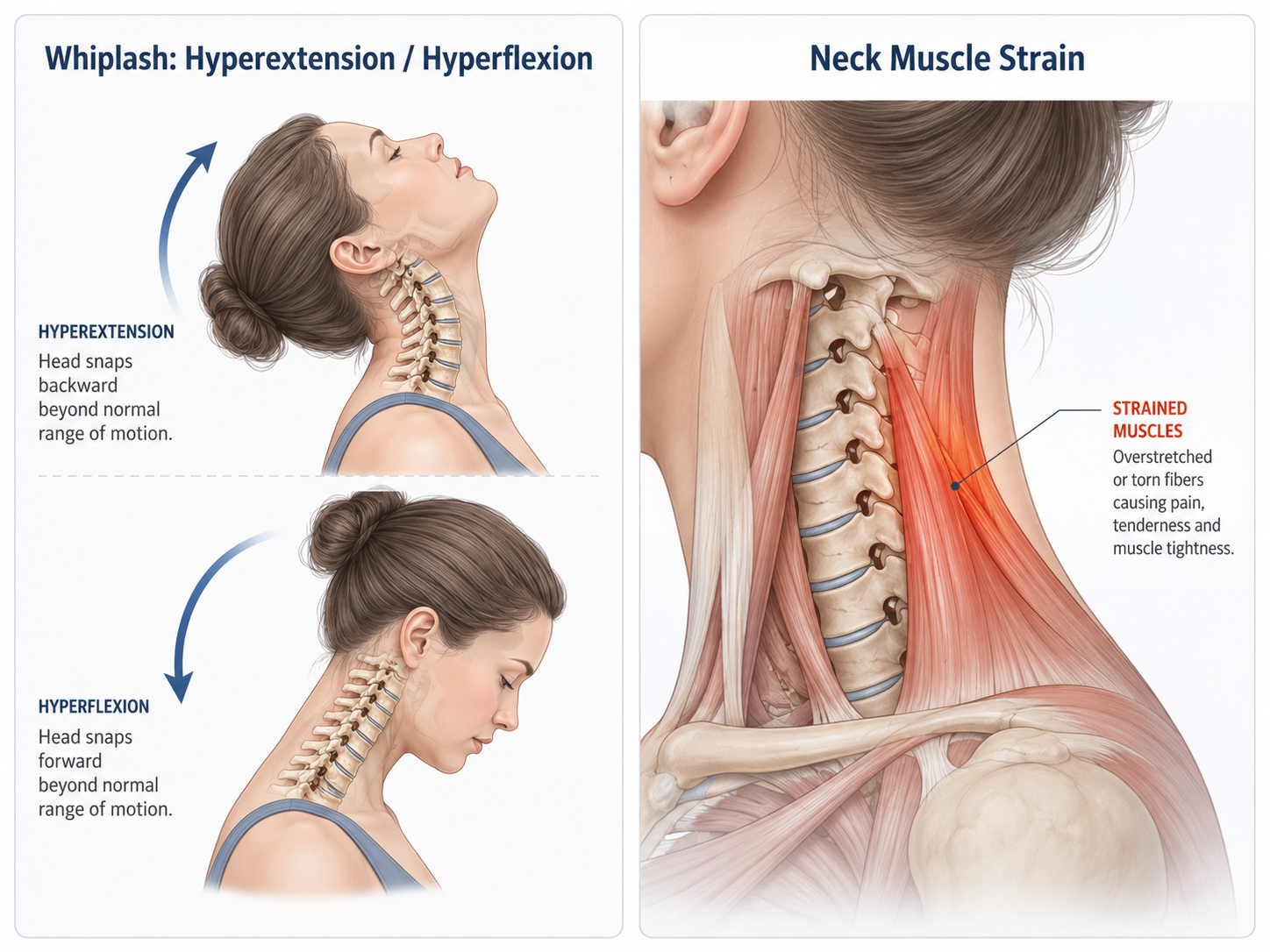
 The key difference between whiplash vs neck strain symptoms comes down to mechanism and depth: whiplash is a rapid back-and-forth “acceleration-deceleration” injury (most often from a car crash) that can damage muscles, ligaments, joints, discs, and nerves at once, while a neck strain is a more localized overstretch or tear of the neck muscles and tendons, usually from poor posture, sleeping wrong, or lifting. As a general rule, if your pain followed a sudden jolt or collision and includes headaches, dizziness, or symptoms spreading into the arms, suspect whiplash and get evaluated promptly. If pain is mainly muscular soreness and stiffness after an everyday activity, it’s more likely a simple strain. Either way, only a qualified clinician can confirm the diagnosis.
Understanding Whiplash
Whiplash is a soft-tissue injury to the neck caused when the head is thrown rapidly forward and backward, forcing the cervical spine through a range of motion it isn’t built to absorb. Clinicians often call the resulting cluster of issues “Whiplash-Associated Disorders” (WAD), because the injury rarely involves just one tissue. A single collision may overstretch muscles, sprain ligaments, irritate the small facet joints, and aggravate the discs and nerve roots simultaneously.
How it happens: The classic cause is a rear-end auto accident, which is why whiplash is so common in a dense, stop-and-go driving city like Chicago — especially during icy winter months when Lake Shore Drive and the Kennedy Expressway turn into low-traction obstacle courses. But whiplash isn’t limited to cars. Slip-and-fall injuries on frozen Chicago sidewalks, contact sports, and even amusement-park rides can produce the same mechanism.
Typical symptoms: Neck pain and stiffness, reduced range of motion, headaches (often starting at the base of the skull), shoulder and upper-back tightness, dizziness, fatigue, and sometimes tingling or numbness radiating into the arms. A hallmark of whiplash is delayed onset — many people feel relatively fine at the scene and only develop significant pain 24 to 72 hours later, once inflammation sets in.
Typical cost of care: Costs vary widely by severity, imaging needs, and how long treatment continues. Conservative chiropractic and rehabilitation care for whiplash in the Chicago area commonly runs from a few hundred dollars for a brief course of treatment to several thousand for more involved, multi-month recovery. The good news for many patients is that when whiplash results from a motor-vehicle collision, care is frequently covered through auto insurance or a personal-injury claim rather than out of pocket. Our team that handles auto accident injuries can walk you through how that documentation works.
Core benefits of prompt whiplash treatment: Early, structured care can reduce the likelihood of lingering chronic pain, restore range of motion faster, and create the medical record that’s often essential for insurance or legal claims. Because whiplash can involve deeper structures, working with a dedicated whiplash specialist is generally recommended over self-management.
Ideal “use case”: Any neck injury that follows a collision, fall, or sudden jolt — particularly when symptoms include headaches, dizziness, or radiating arm symptoms — warrants a whiplash-focused evaluation.
Understanding Neck Strain
A neck strain (sometimes loosely called a “pulled neck muscle”) is an injury to the muscles or tendons of the neck, typically from overstretching or small tears. A closely related injury, a neck sprain, affects the ligaments — but in everyday language people use “strain” for both. Compared with whiplash, a strain is usually more localized and more clearly tied to muscle tissue.
 How it happens: Strains build up from everyday stress rather than a single violent event. Common culprits include hunching over a laptop, “tech neck” from looking down at a phone, sleeping in an awkward position, carrying a heavy bag on one shoulder, or sudden overexertion. Chicago’s long desk-bound winters — when commuters are bundled, tense against the cold, and spending more hours indoors and seated — are a reliable season for posture-related neck strain.
Typical symptoms: Muscle pain and tightness, soreness that worsens with movement, stiffness, muscle spasms, and tenderness when you press on the affected area. Crucially, a simple strain usually does not produce the dizziness, significant headaches, or arm tingling that point toward whiplash. Onset also tends to be more immediate and clearly linked to the triggering activity.
Typical cost of care: Mild strains often resolve with rest, gentle movement, and home care at little to no cost. When professional treatment is needed, a short course of chiropractic care, manual therapy, or modalities like hot and cold therapy in the Chicago area is generally more affordable than long-term whiplash rehabilitation, simply because recovery is usually shorter.
Core benefits of treatment: Targeted care relieves muscle tension, addresses the underlying postural or ergonomic cause, and helps prevent the strain from becoming a recurring problem. General chiropractic care and neck pain treatment are well suited to most strains.
Ideal “use case”: Localized neck soreness and stiffness that follows poor posture, awkward sleep, or routine overexertion — without neurological symptoms — typically reflects a strain.
Side-by-Side Comparison
When patients ask us to summarize whiplash vs neck strain symptoms, this is the clearest way to see them side by side:
Pros and Cons Breakdown
Because these are injuries rather than products, “pros and cons” here means the practical upsides and risks of each situation — and what they mean for your recovery decisions.
Whiplash
Pros (in your favor):
- Often insurance-covered. When tied to a Chicago auto accident, treatment is frequently paid through auto or personal-injury claims.
- Well-studied recovery pathways. Established, evidence-informed protocols exist for guiding recovery.
- Strong reason to document. The injury creates a clear case for thorough medical records that protect you legally and financially.
Cons (the risks):
- Deeper, multi-tissue damage. More structures can be involved, so it’s harder to self-assess.
- Delayed symptoms. People often underestimate the injury because pain shows up days later.
- Chronic-pain risk. Untreated whiplash can linger for months or become a long-term issue.
Neck Strain
Pros (in your favor):
- Often self-limiting. Many strains improve on their own with rest and gentle movement.
- Lower cost and shorter recovery. Care, when needed, is usually brief.
- Clear, fixable causes. Posture and ergonomics can be corrected to prevent recurrence.
Cons (the risks):
- Easy to re-injure. Without addressing the root cause, strains come back.
- Can mask something bigger. “Just a strain” sometimes turns out to be more, which is why persistent pain deserves evaluation.
- Disruptive while it lasts. Even a minor strain can limit sleep, work, and driving.
Which Injury Needs More Urgent Attention? (The Real “Showdown”)
With most comparison topics you’d crown a winner — but with whiplash vs neck strain symptoms, the honest answer is that neither is a prize you want. The useful question isn’t “which is better,” it’s “which needs faster, more thorough attention.” Here’s the practical breakdown:
Treat it as whiplash (and seek prompt care) if: your pain followed any collision, fall, or violent jolt; symptoms appeared or worsened a day or two later; or you have headaches, dizziness, or tingling spreading into the shoulders or arms. Whiplash wins the urgency contest because its potential to involve discs, joints, and nerves makes self-diagnosis unreliable, and because early documentation matters for both your health and any workers’ compensation injury or auto-injury claim. In a city like Chicago, where winter collisions and icy falls spike every year, erring toward a whiplash evaluation is the safer call.
Treat it as a strain (and start with conservative care) if: your pain is clearly muscular, tied to posture or an everyday activity, localized to one area, and not accompanied by neurological symptoms. In that scenario, rest, gentle stretching, and modalities such as hot and cold therapy are a reasonable first step, with professional chiropractic adjustments added if pain persists past a week.
The bottom line: when symptoms overlap and you genuinely can’t tell, default to getting evaluated. The cost of a professional assessment is small compared with the cost of mismanaging a whiplash injury that needed care. This is general guidance, not a diagnosis — a hands-on examination is the only way to know for sure.
A Note for Chicago Residents: Get Clarity Before You Guess
If you’re sorting through whiplash vs neck strain symptoms after a fender-bender on the Dan Ryan, a slip on an icy stretch of sidewalk, or a long stretch of desk work, you don’t have to figure it out alone. Grandview Health Partners helps Chicago patients pinpoint the source of neck pain and build a recovery plan that fits the injury — whether that’s a few sessions for a strain or a structured program for whiplash. Reach out for a consultation, or explore our neck pain treatment options and care for auto accident injuries to learn more. You can also read our guide on effective chiropractic treatment for whiplash after a Chicago car accident.
Conclusion & Recommendation
Whiplash and neck strain can feel similar in the first day or two, but they’re different injuries with different stakes. A neck strain is usually a localized, muscular problem that often resolves with rest and conservative care. Whiplash is a deeper, multi-tissue injury — frequently from a Chicago auto accident — that deserves prompt, professional evaluation because of its delayed-symptom pattern and chronic-pain risk. Our recommendation is simple: if your injury followed any collision or fall, or if you notice headaches, dizziness, or arm symptoms, treat it as whiplash and get checked. If it’s clearly muscular and posture-related, start conservatively and seek care if it lingers. When in doubt, an evaluation removes the guesswork. For broader context, our upper and lower back pain resources and our overview of neck pain chiropractic care in Chicago are good next reads.
Frequently Asked Questions
1. What’s the main difference between whiplash and a neck strain?
1. What’s the main difference between whiplash and a neck strain?
Whiplash is caused by a rapid back-and-forth motion (typically a collision) and can damage multiple tissues — muscles, ligaments, joints, discs, and nerves. A neck strain is usually a more localized overstretch of the neck muscles and tendons from things like poor posture or sleeping wrong. Whiplash also tends to involve symptoms like headaches and dizziness that a simple strain does not.
2. Can whiplash symptoms be delayed?
2. Can whiplash symptoms be delayed?
Yes. One of the defining features of whiplash is delayed onset — many people feel okay right after an accident and only develop noticeable neck pain, stiffness, or headaches 24 to 72 hours later as inflammation builds. That’s why prompt evaluation is wise even if you initially feel fine.
3. How long does each injury take to heal?
3. How long does each injury take to heal?
A neck strain often improves within days to a few weeks with rest and gentle care. Whiplash recovery is more variable — it can take several weeks to a few months depending on severity and how quickly treatment begins. Individual recovery times differ, so these are general ranges, not guarantees.
4. When should I see a chiropractor in Chicago for neck pain?
4. When should I see a chiropractor in Chicago for neck pain?
Seek care promptly if your pain followed a car accident, fall, or sudden jolt, or if you have headaches, dizziness, numbness, or tingling. For a milder, clearly muscular strain, it’s reasonable to try conservative home care first and see a professional if the pain persists beyond about a week or gets worse.
5. Is whiplash covered by insurance?
5. Is whiplash covered by insurance?
Often, yes — when whiplash results from a motor-vehicle collision, treatment is frequently covered through auto insurance or a personal-injury claim, and work-related neck injuries may fall under workers’ compensation. Coverage depends on your specific policy and situation, so it’s best to confirm the details with your provider and clinic.
6. Can a neck strain turn into something more serious?
6. Can a neck strain turn into something more serious?
A true muscle strain usually heals well, but neck pain that doesn’t improve, keeps recurring, or comes with neurological symptoms shouldn’t be assumed to be “just a strain.” Persistent or worsening pain deserves a professional evaluation to rule out deeper involvement.
7. Why is whiplash so common in Chicago?
7. Why is whiplash so common in Chicago?
Chicago’s dense, congested traffic and harsh winters are a big factor. Rear-end collisions spike on icy expressways and city streets, and slips on frozen sidewalks can produce the same whiplash mechanism. Both make neck injuries a year-round — but especially winter — concern for local residents.
8. Can I tell the difference between whiplash and a neck strain on my own?
8. Can I tell the difference between whiplash and a neck strain on my own?
You can look for clues — mechanism of injury, delayed symptoms, and the presence of headaches or arm tingling all point toward whiplash — but you can’t reliably self-diagnose. Because whiplash can involve deeper structures, a hands-on examination by a qualified clinician is the only way to know for certain.


