
 If a sharp, burning, or shooting pain travels from your lower back down through your hip and leg, you may be dealing with sciatica — and you don’t have to live with it. At Grandview Health Partners in Chicago, our team provides non-invasive sciatica treatment in Chicago designed to address the source of the irritated nerve, not just mask the symptoms. We focus on relieving pressure on the sciatic nerve so you can sit, stand, walk, and sleep with less pain.
Sciatica affects people across every Chicago neighborhood, from desk workers downtown to warehouse and trades workers on the South and West Sides. Whether your pain started after a car accident, a workplace injury, or simply built up over years of poor posture and long commutes, our chiropractic team is here to help you understand what’s happening and what to do next.
Why Sciatica Treatment Matters
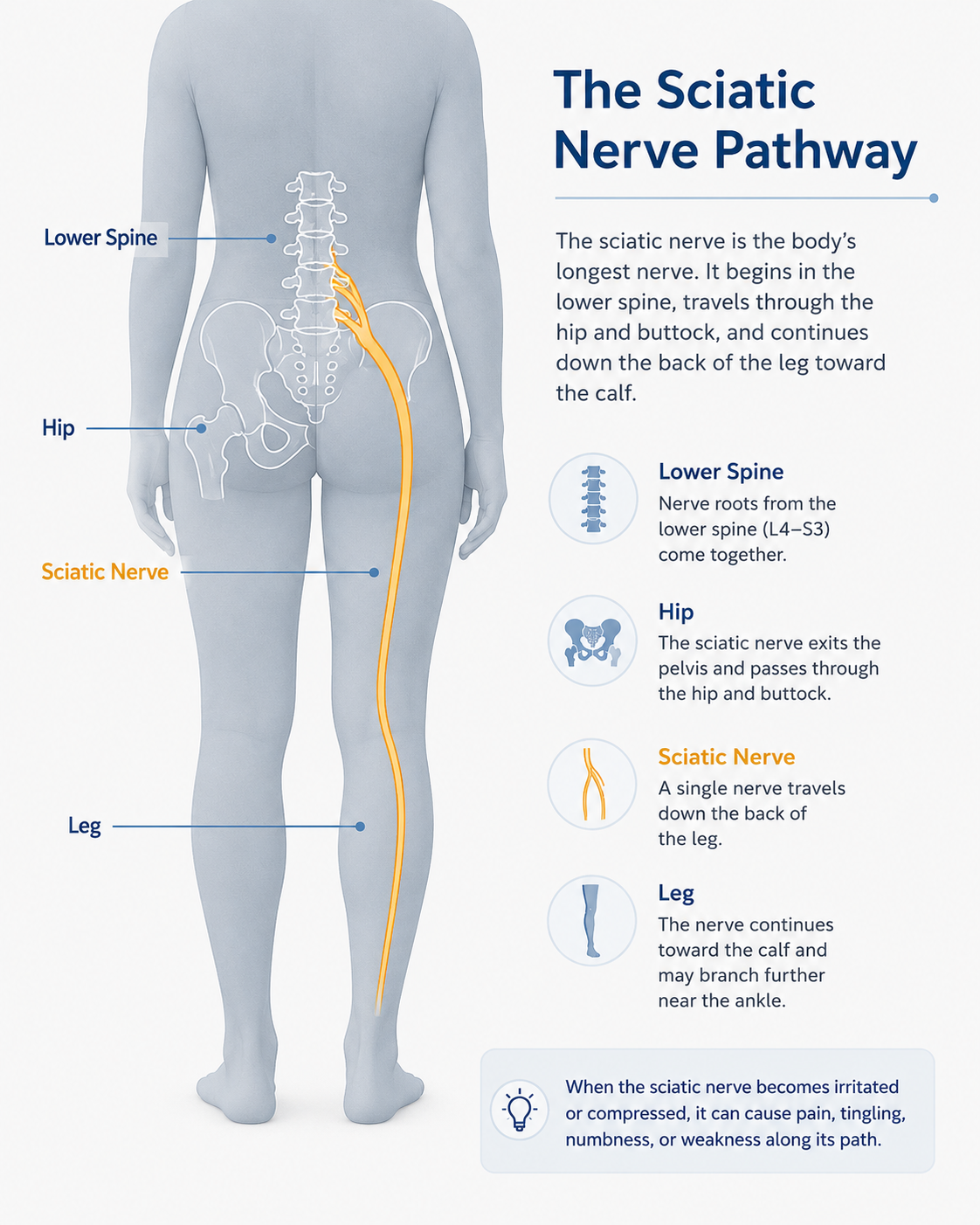
Sciatica isn’t a diagnosis on its own — it’s a set of symptoms caused by compression or irritation of the sciatic nerve, the largest nerve in the body. When that nerve gets pinched by a herniated disc, bone spur, tight muscle, or spinal misalignment, the pain can radiate from the lower back all the way to the foot.
Left unaddressed, sciatica tends to interfere with the basics of daily life. Many patients report trouble sleeping, difficulty driving, and pain that makes sitting through a workday miserable. Some people compensate by changing how they walk or move, which can create new problems in the hips, knees, and opposite leg over time.
Early, conservative care matters because it often gives the body the best chance to recover without surgery or long-term reliance on medication. Acting sooner — rather than waiting for the pain to “go away on its own” — can help prevent a flare-up from becoming a chronic problem. If you’re noticing numbness, tingling, or weakness in your leg, that’s a signal worth taking seriously.
Common Problems Sciatica Treatment Solves
People come to us for help with a range of sciatica-related complaints. Our care is often a good fit if you’re experiencing:
- Radiating leg pain that travels from the lower back or buttock down the back of the thigh and calf.
- Numbness or tingling (“pins and needles”) in the leg, foot, or toes.
- A herniated or bulging disc in the lumbar spine that’s pressing on the nerve root. Many patients find it helpful to read more about how chiropractic care addresses herniated discs before their first visit.
- Piriformis-related pain, where a tight muscle deep in the buttock irritates the sciatic nerve.
- Pain that worsens when sitting, coughing, sneezing, or standing up after rest.
- Post-accident sciatica that began after a car crash or fall. Sciatica is a common consequence of spinal trauma, and our auto accident injury care is built around exactly these situations.
- Difficulty with hips, knees, or gait caused by compensating for nerve pain. Related issues are covered in our hip and knee pain services.
If you’re still researching your symptoms, our overview of sciatica causes, symptoms, and treatments breaks down the most common triggers in plain language.
Our Sciatica Treatment Process
 We keep our process clear and patient-centered. Here’s what working with our Chicago team typically looks like:
Step 1 — Consultation and history. We start by listening. You’ll describe your pain, when it started, what makes it better or worse, and how it’s affecting your daily life. This conversation guides everything that follows.
Step 2 — Examination and assessment. We perform a physical and orthopedic evaluation to locate the source of the nerve irritation. Where appropriate, this may include movement and reflex testing to understand which structures are involved. Our broader chiropractic care approach is always evaluation-first.
Step 3 — A personalized care plan. No two cases of sciatica are identical, so your plan is built around your findings and goals. This may combine chiropractic adjustments to improve spinal alignment with supportive therapies.
Step 4 — Targeted treatment. Depending on your case, care may include spinal adjustments, mechanical traction to gently decompress the spine, electrical muscle stimulation to ease muscle tension, and stretches designed to reduce pressure on the nerve.
Step 5 — Progress checks and prevention. As you improve, we adjust your plan and share posture, movement, and ergonomic guidance to help reduce the chance of recurrence. Many patients pair sciatica care with ongoing back pain management.
It’s worth noting that results vary from person to person, and we’ll always be honest with you about what we expect — and when another type of care or referral may be a better fit.
Why Choose Grandview Health Partners
Grandview Health Partners is a Chicago chiropractic and accident-injury clinic focused on conservative, hands-on care. People in the Chicago area choose us for several reasons:
- A whole-person approach. We don’t just treat the spot that hurts. We look at posture, movement, and the underlying cause of nerve irritation so improvements are more likely to last.
- Experience with accident and work injuries. Sciatica frequently follows car crashes and on-the-job incidents, and our team is comfortable coordinating care for those situations.
- Clear communication. We explain what’s happening in your spine and what your options are — without pressure and without confusing jargon.
- Convenient Chicago location. We serve patients from across the city and surrounding communities, making it easier to keep up with a care plan that depends on consistency.
We avoid overpromising. Chiropractic care helps many people manage and reduce sciatica, but we’ll always give you a realistic picture of your situation.
Serving Chicago and the Surrounding Area
Our clinic sits on Chicago’s southwest side, and we welcome patients from across the city and nearby communities. Chicago living comes with its own contributors to sciatica: long winters that keep people sedentary indoors, snow-shoveling strains, hours behind the wheel on the Stevenson, Dan Ryan, and Kennedy, and physically demanding jobs in construction, manufacturing, warehousing, and the trades.
Cold weather often makes nerve and muscle pain feel worse, and the stop-and-go reality of Chicago commuting means a lot of time sitting — one of the most common aggravators of sciatic pain. We see these patterns regularly in patients from neighborhoods across the South and West Sides and from the surrounding suburbs.
Workplace-related sciatica is especially common here, which is why we also support workers’ comp injury cases. If your pain is tied to a job in one of Chicago’s industrial or service sectors, we can help you understand your care options. You can also read more about recovering from common workplace injuries in Chicago.
Cost, Timeline, and What to Expect
The honest answer is that it depends. The cost and length of sciatica treatment vary based on factors such as:
- The underlying cause — a tight muscle responds differently than a herniated disc.
- How long you’ve had symptoms — recent flare-ups often respond faster than long-standing, chronic cases.
- Your overall health, activity level, and consistency with your care plan.
- Whether your sciatica is tied to an auto accident or work injury, which can affect how care is billed and documented.
Some patients feel meaningful relief within a few visits, while others with more complex cases need a longer, structured plan. Because every spine is different, we’ll give you a clearer estimate of expected timeline and visit frequency after your initial evaluation — not before. We’ll also be upfront about costs and any documentation we can provide for insurance, auto, or workers’ compensation claims.
The most important step is the first one. The sooner sciatica is evaluated, the more options you typically have for conservative, non-surgical care.
Frequently Asked Questions
What is the best treatment for sciatica in Chicago?
What is the best treatment for sciatica in Chicago?
There’s no single “best” treatment, because sciatica has many causes. For many people, conservative care — like chiropractic adjustments, spinal decompression, stretching, and muscle therapy — is an effective first step because it targets the source of nerve irritation without surgery or long-term medication. At Grandview Health Partners in Chicago, we evaluate your specific case first, then build a plan around it. The right approach depends on what’s actually compressing your sciatic nerve.
How long does sciatica take to heal with chiropractic care?
How long does sciatica take to heal with chiropractic care?
It varies. Mild, recent cases sometimes improve within a few visits, while chronic or disc-related sciatica may need a longer, structured care plan. Healing time depends on the cause, how long you’ve had symptoms, your overall health, and how consistent you are with treatment and at-home guidance. After your first evaluation in our Chicago clinic, we can give you a more realistic timeline for your individual situation.
Can a chiropractor help with sciatica, or do I need surgery?
Can a chiropractor help with sciatica, or do I need surgery?
Many people with sciatica improve with conservative chiropractic care and never need surgery. Chiropractic focuses on relieving pressure on the sciatic nerve through adjustments, decompression, and supportive therapies. Surgery is generally considered only for severe or unresponsive cases, or when there are red-flag symptoms. We’ll always be honest about whether chiropractic care is a good fit for you and refer out when another approach is more appropriate.
Is sciatica treatment covered by insurance or auto/workers’ comp in Illinois?
Is sciatica treatment covered by insurance or auto/workers’ comp in Illinois?
It often can be, depending on your plan and how your sciatica started. If your nerve pain followed a car accident or a workplace injury, your care may be billable through auto insurance or workers’ compensation. Coverage details vary by case and policy. Our Chicago team can explain what documentation we provide and help you understand your options during your first visit.
What does sciatica feel like?
What does sciatica feel like?
Sciatica usually feels like a sharp, burning, or shooting pain that radiates from the lower back or buttock down through the back of the leg, sometimes reaching the foot. Many people also notice numbness, tingling (“pins and needles”), or weakness in the affected leg. The pain often worsens when sitting, standing up, coughing, or sneezing. If you’re feeling these symptoms, it’s worth getting evaluated.
Should I see a chiropractor for sciatica right away or wait it out?
Should I see a chiropractor for sciatica right away or wait it out?
While some mild cases ease on their own, waiting can allow a flare-up to become a longer-lasting problem. Early evaluation generally gives you more conservative, non-surgical options. You should seek care promptly if you have significant leg weakness, numbness, or pain that interferes with daily life. When in doubt, an exam is the safest way to understand what’s causing your symptoms.
Do you treat sciatica from car accidents in Chicago?
Do you treat sciatica from car accidents in Chicago?
Yes. Sciatica is a common result of spinal trauma from car crashes, and our clinic regularly helps Chicago patients recovering from auto accidents. Crash forces can herniate discs or misalign the spine, irritating the sciatic nerve. We evaluate accident-related injuries, build a care plan, and provide documentation that may support insurance or injury claims. The sooner you’re assessed after an accident, the better.


