
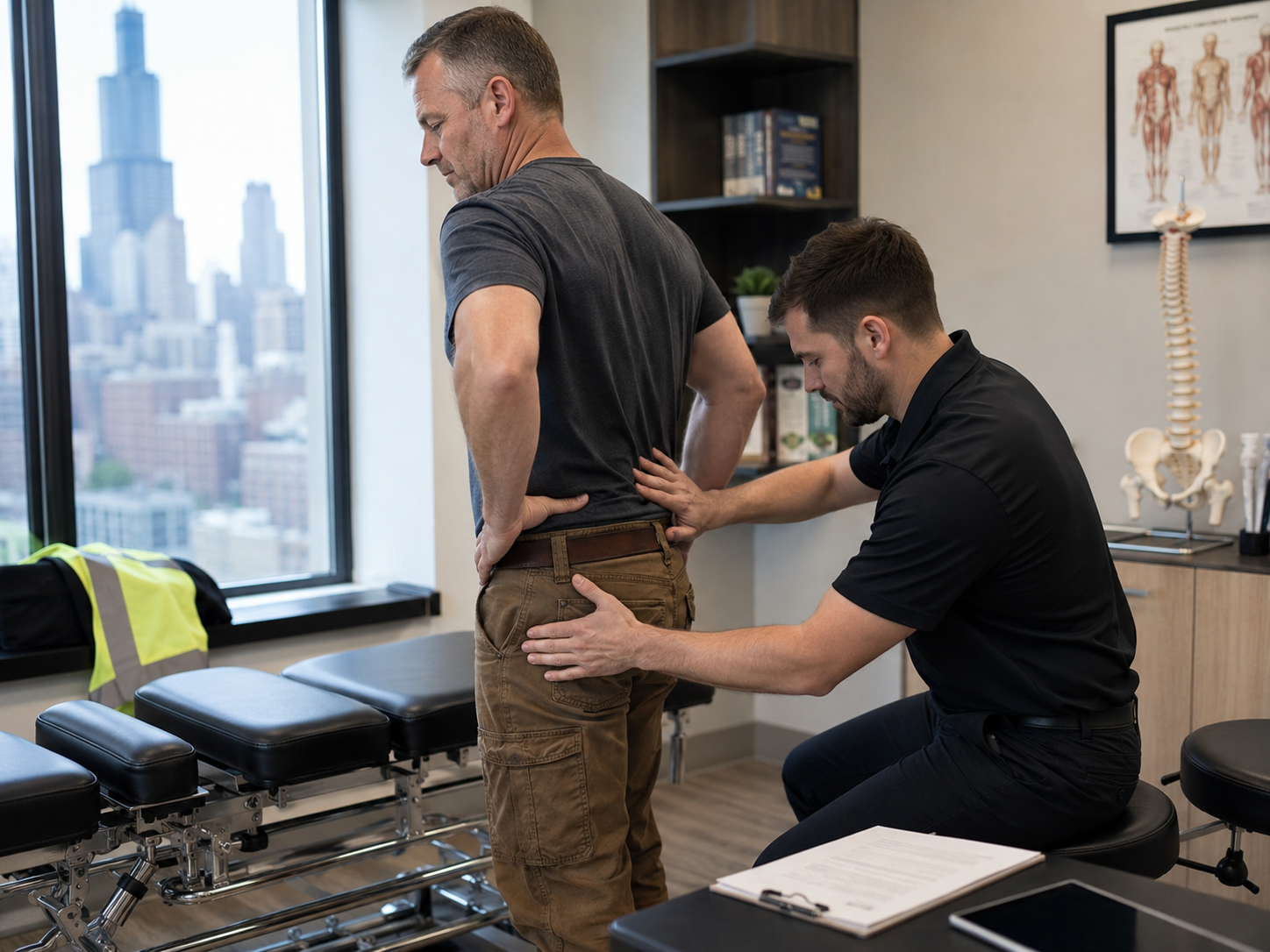
 A work injury can change your week, your paycheck, and your peace of mind in a single moment. Whether you strained your back lifting on a warehouse floor, slipped on an icy loading dock, or developed nagging wrist and shoulder pain from years of repetitive tasks, you need care that treats the injury and keeps your claim on solid footing. Grandview Health Partners is a workers’ compensation chiropractor in Chicago focused on exactly that: getting you out of pain, documenting your injury properly, and helping you move toward a safe return to work.
We treat injured workers from across the city and the surrounding area, and we understand how stressful it is to manage pain while also worrying about bills, paperwork, and your job. Our role is to take the medical side off your plate. From your first visit, we evaluate what happened, build a treatment plan tailored to your injury, and keep the kind of clear records that workers’ compensation cases depend on.
If you were hurt on the job, you have rights — and one of the most important is your right to choose where you receive treatment.
Why a Workers’ Compensation Chiropractor in Chicago Matters
Under the Illinois Workers’ Compensation Act (820 ILCS 305), injured employees generally have the right to choose their own treating physician — commonly described as the “two-doctor rule.” In most cases, you may select up to two providers of your choice, plus any specialists or therapists those providers refer you to. Emergency room and first-aid care typically do not count as one of those choices, and chiropractors are permitted to treat work-related injuries in Illinois. (Your specific rights can depend on whether your employer has a Preferred Provider Program, so it’s wise to confirm the details with your employer or a workers’ compensation attorney.)
Why does this matter? Because the choice you make early can shape your entire recovery. A provider who understands work injuries knows how to document mechanism of injury, functional limitations, and work restrictions in a way that supports both your health and your claim. Skipping or delaying care — or seeing a provider who doesn’t regularly handle workers’ comp — can leave gaps that insurers later use to question your treatment.
Acting quickly protects you in two ways. First, soft-tissue injuries, joint dysfunction, and spinal misalignments tend to worsen and become harder to treat when ignored. Second, Illinois generally asks injured workers to report a workplace injury to their employer promptly (within 45 days for many claims). The sooner you’re evaluated and your injury is on record, the stronger your position. You can learn more in our overview of common workplace injuries we treat across Chicago.
Common Problems This Service Solves
 Work injuries rarely fit a single mold. Some happen in an instant; others build up over months. Here are the situations we see most often from Chicago workers:
- Lower and upper back injuries from lifting, twisting, or sudden loads — one of the most common reasons people seek a work-injury chiropractor. We address these through targeted back pain treatment for upper and lower back.
- Neck pain and stiffness, including injuries from falls or being struck by equipment. Our neck pain treatment focuses on restoring range of motion and reducing inflammation.
- Sciatica and radiating leg pain caused by disc irritation or nerve compression after a lifting or fall injury. See how we approach sciatica relief.
- Repetitive strain injuries from assembly lines, keyboards, cash registers, or tools — conditions that creep in gradually. Our care for repetitive strain injury targets the cumulative wear these jobs create.
- Shoulder, arm, and elbow pain from overhead work or sudden impact.
- Whiplash and joint injuries from slips, trips, falls, and on-the-job vehicle accidents.
If your symptoms include numbness, tingling, weakness, headaches, or pain that travels down an arm or leg, those are signals worth evaluating sooner rather than later. Many of these injuries respond well to conservative, non-surgical care when addressed early. You can read more about how chiropractic care supports recovery in our guide on regaining mobility with a workers’ compensation chiropractor in Chicago.
Our Workers’ Compensation Care Process
We keep the process clear so you always know what comes next.
Step 1 — Initial consultation and exam. We listen to how your injury happened, review your symptoms, and perform a thorough orthopedic and neurological evaluation. If imaging or additional testing is appropriate, we’ll coordinate it.
Step 2 — Diagnosis and documentation. We identify what’s injured and create the detailed records workers’ comp cases rely on, including mechanism of injury and any work restrictions. The value of thorough records is something we cover in our piece on the importance of a chiropractic medical report after a work accident.
Step 3 — Personalized treatment plan. Depending on your injury, your plan may include chiropractic adjustments, soft-tissue therapy, therapeutic exercise, and supporting modalities such as pain management approaches.
Step 4 — Progress tracking and re-evaluation. We monitor how you respond, adjust your plan as you improve, and document your progress at each stage.
Step 5 — Return-to-work support. As you recover, we help define safe activity levels and work restrictions, with the goal of returning you to your job without re-injury.
Why Choose Grandview Health Partners
Injured workers in Chicago choose us because we combine hands-on chiropractic care with a clear understanding of how work-injury claims actually work. We focus on:
- Work-injury experience. We treat job-related injuries regularly and know how to evaluate, treat, and document them.
- Thorough records. Detailed documentation supports both your recovery and your claim — and helps reduce disputes over treatment.
- Patient-centered care. Your plan is built around your specific injury, your job demands, and your recovery goals, not a one-size-fits-all template.
- Conservative, non-surgical focus. We aim to relieve pain and restore function using proven, non-invasive methods whenever appropriate.
- Communication you can count on. We explain your condition in plain language and keep you informed at every step.
We also serve as part of your broader care team. When a case calls for it, we coordinate care and referrals so your treatment stays connected and well-documented. For more on what to expect, see our article on how chiropractic care can help after a workplace injury in Chicago.
Serving Injured Workers Across Chicago and Nearby Areas
Chicago is a working city — and that means a wide range of work injuries. From the warehouses and distribution centers on the Southwest Side to construction sites, healthcare facilities, restaurants, retail floors, and office buildings throughout the metro area, the demands of these jobs put real strain on the spine, joints, and soft tissues.
Local conditions add to the risk. Chicago winters bring ice and snow that turn loading docks, parking lots, sidewalks, and stairwells into slip-and-fall hazards for months at a time. Manufacturing and logistics work involves heavy lifting and repetitive motion. Long shifts and aging facilities only compound the wear on a worker’s body.
We’re positioned to serve injured workers from across Chicago and the surrounding communities, making it convenient to start care close to home or work. Wherever you’re coming from in the area, our focus stays the same: prompt evaluation, effective treatment, and documentation that holds up. If your injury came from a job-site accident specifically, our work injury chiropractor resources for Chicago walk through what to expect.
Cost, Timeline, and What to Expect
One of the most common questions injured workers ask is, “What will this cost me?” In most accepted Illinois workers’ compensation claims, the employer’s insurance is responsible for reasonable and necessary medical treatment related to the work injury — which can include chiropractic care, physical therapy, and related services. That generally means little to no out-of-pocket cost to you for covered, authorized treatment. Coverage specifics depend on your individual claim, your employer’s program, and what the insurer authorizes, so we recommend confirming details with your claims adjuster or attorney.
How long does recovery take? That depends on the injury. Mild strains and sprains may improve within a few weeks, while disc injuries, repetitive-strain conditions, or injuries involving multiple areas can take longer and require a more gradual plan. Your timeline depends on factors such as:
- The type and severity of your injury
- How soon treatment began after the injury
- Your overall health and the physical demands of your job
- How consistently you follow your treatment plan
We’ll give you an honest picture at your first visit and update it as you progress. Our goal is always meaningful relief and a safe, well-supported return to work — not endless visits.
Frequently Asked Questions
Can I choose my own chiropractor for a workers’ comp injury in Illinois?
Can I choose my own chiropractor for a workers’ comp injury in Illinois?
In most cases, yes. Under the Illinois Workers’ Compensation Act, injured workers generally have the right to choose their own treating provider — often described as the “two-doctor rule” — along with any specialists those providers refer you to. Chiropractors are permitted to treat work injuries in Illinois. If your employer has a Preferred Provider Program, the rules may differ slightly, so it’s smart to confirm with your employer or a workers’ comp attorney before scheduling ongoing care.
Does workers’ compensation cover chiropractic care in Chicago?
Does workers’ compensation cover chiropractic care in Chicago?
In accepted Illinois workers’ compensation claims, the employer’s insurance is typically responsible for reasonable and necessary medical treatment related to the injury, which can include chiropractic care. For covered, authorized treatment, that usually means little to no out-of-pocket cost to you. Exact coverage depends on your claim and what the insurer approves, so we’ll help you understand the process at your first visit.
How soon should I see a chiropractor after a work injury?
How soon should I see a chiropractor after a work injury?
As soon as possible. Early evaluation helps prevent injuries from worsening and ensures your condition is documented promptly. Illinois generally asks workers to report a workplace injury to their employer quickly — within 45 days for many claims. Prompt care protects both your recovery and your claim, since gaps in treatment can give insurers a reason to question it later.
What types of work injuries do you treat?
What types of work injuries do you treat?
We treat a wide range of job-related injuries, including lower and upper back strains, neck pain, sciatica, whiplash, shoulder and elbow pain, and repetitive strain injuries from lifting, falls, or repetitive tasks. Whether your injury happened in a single moment or built up over time, we evaluate the cause, create a tailored treatment plan, and document your care thoroughly.
Will you provide records for my workers’ comp claim?
Will you provide records for my workers’ comp claim?
Yes. Detailed documentation is a core part of how we work. We record the mechanism of injury, your symptoms, functional limitations, work restrictions, and your progress at each stage. These records support your recovery and help reduce disputes over treatment, which is one reason proper documentation is so important in workers’ compensation cases.
Do I need a referral to start chiropractic care for a work injury?
Do I need a referral to start chiropractic care for a work injury?
Generally, Illinois law allows injured workers to choose their own treating provider directly without a referral, subject to the two-doctor rule and any Preferred Provider Program your employer may have. The simplest step is to call us — we’ll explain how your choice of provider works under your specific situation and help you get started.
What if I’m still in pain but my employer wants me back at work?
What if I’m still in pain but my employer wants me back at work?
This is a common and stressful situation. Our role is to evaluate your condition objectively, document any work restrictions, and communicate what level of activity is safe based on your recovery. We focus on getting you back to work in a way that doesn’t risk re-injury, and we keep clear records that reflect your actual functional status.


